
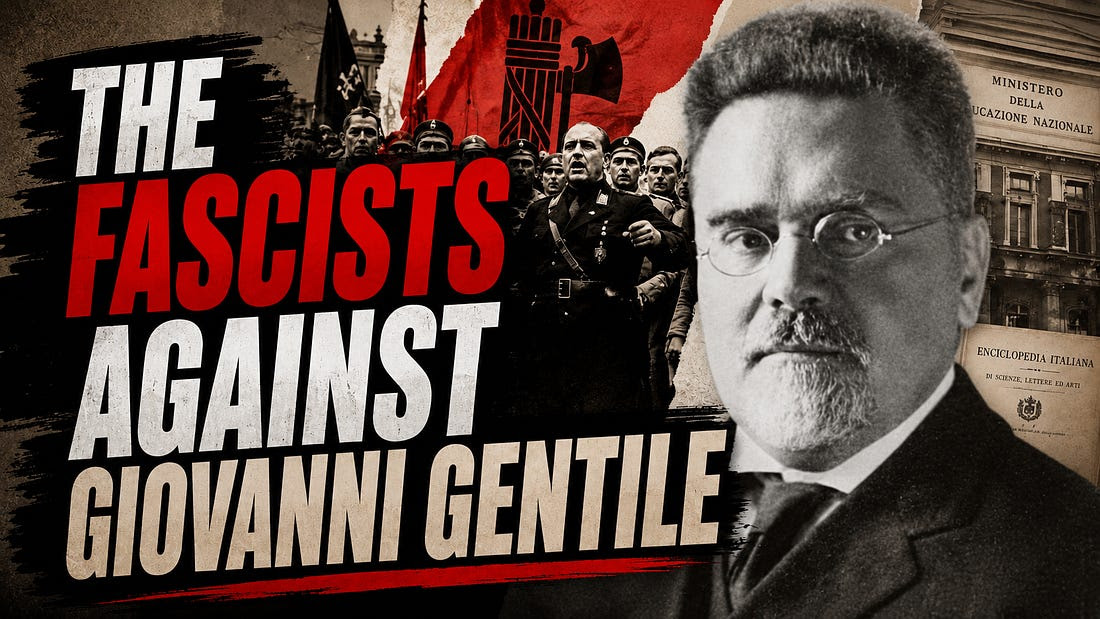
He fascists against Giovanni Gentille and actual idealism
Par Zoltaneous
Abonnez-vous au canal Telegram Strategika pour ne rien rater de notre actualité
Pour nous soutenir commandez les livres Strategika : “Globalisme et dépopulation” , « La guerre des USA contre l’Europe » et « Société ouverte contre Eu
Giovanni Gentile gave Italian Fascism its most systematic philosophical voice. Actualism presented spirit as pure act and the state as the living synthesis in which the individual realizes universality through the ethical community. Mussolini acknowledged the contribution directly; “It was Gentile who paved the way for those, like myself, who wished to follow it.” Even Benedetto Croce described him as “the most staunch Hegelian in Western philosophy” and “the official philosopher of Fascism.” Yet this philosophical articulation, however rigorous and institutionally powerful in the early years, never functioned as the regime’s sole or final justification. Gentile secured decisive influence over education, cultural institutions, and early programmatic statements between 1922 and 1926, but alternative currents inside the Fascist camp offered competing accounts of the revolutionary project from the outset. These debates demonstrate that Fascist ideology remained plural and in formation even as the regime moved toward fuller legal and institutional consolidation after the Matteotti crisis and through the exceptional laws of 1925–1926. Hegemony in key apparatuses did not produce doctrinal monopoly; the totalitarian turn unfolded amid ongoing intellectual contest over first principles.
“Il Secolo, a leading anti-Fascist daily, for example, noted on 4 November, There isn’t a party or political movement in Italy in which there are, as in Fascism, so many currents which flow in opposite directions, each one acting for itself, with no respect either for discipline, or central leadership.”
— Il Secolo, 4 November quotes in Mussolini: A New Life by Nicholas Farrell
Gentile entered government in October 1922 already established as one of Italy’s leading philosophers. His major works of the 1910s had laid the foundations of Actual Idealism. Years of secondary-school teaching convinced him that pedagogical renewal was essential for completing the Risorgimento’s unfinished task, the creation of a spiritually united national community. After the war he and his collaborators worked through journals and the Federazione Nazionale Insegnanti Scuole Medie. In 1919 they formed the Fascio di Educazione Nazionale. Its leaders entered the Fascist party as the specialist group on education shortly before the March on Rome. The terms of the alliance appear plainly in private correspondence. On 9 September 1922 Ernesto Codignola wrote to Camillo Pellizzi:
“We are ready to join the Fascist Party, for we are in perfect agreement with its political principles, but we should like our participation to result in the Party paying more attention to the problems of education which we consider essential for the goals pursued by the Party. I do not know how Mussolini feels about this…. Do you plan to travel to Milan before returning to England? Would it not make sense for me, yourself, and Casotti to meet with Mussolini?”
— Ernesto Codignola to Camillo Pellizzi, Pisa, 9 September 1922 (Fondazione Ugo Spirito, Archivio Camillo Pellizzi, b. 17)
Mussolini confirmed the meeting by telegram on 15 September; Codignola presented the reform program and proposed Gentile’s name. A further letter on 18 October reiterated the same principles. Gentile’s formal adherence — PNF membership in May 1923, served as the vehicle for this long-prepared educational and spiritual project. Intransigent Fascists who demanded that the revolution remain revolutionary immediately treated Gentile’s philosophy as too marked by the modern world it claimed to supersede. Curzio Suckert (Malaparte), editing La Conquista dello Stato, attacked in October 1924 the decision to entrust constitutional reform to a committee chaired by Gentile. He saw the move as an effort to fold the revolution into the existing constitutional order. His deeper objection was civilizational, liberalism for Suckert represented the triumph of bourgeois individualism born of the Protestant Reformation outside Italy; German Idealism and its Italian variant were the authoritative expressions of that alien modernity descending from Descartes and Kant. Fascism, in this reading, was to be a new Counter-Reformation restoring Catholic tradition.
Gentile therefore appeared as the epigone of everything the revolution must overcome. The attack intensified after the April 1925 Manifesto of the Fascist Intellectuals, which Gentile had drafted. Mario Carli wrote in L’Impero that the Bologna Conference had assigned the task to one of the latest men to join Fascism. In his view the philosopher would never develop a genuine Fascist temperament and had failed to state that Fascism is above all a question of temperament. Giuseppe Brunati put the objection more sharply:
“It is above all against the mindset of this pedagogue who obstinately presumes to be the spiritual father of fascism, its theologian, its teacher, in short, its inspiration, that we protest . . . against the pachydermatous pedantry full of nineteenth-century metaphysics as understood with the heart and the feet of a quarrelsome liberal.”
— Giuseppe Brunati, Il Sabaudo, 25 April 1925
Giuseppe Attilio Fanelli, through Il Secolo fascista, maintained the most sustained campaign, advocating a return to pre-capitalist society and absolute monarchy in the spirit of Louis XIV, de Maistre, and Maurras. In 1931 he and Carli published an anthology of Fascist writers that deliberately excluded Gentile. The Enciclopedia Italiana controversy, which Gentile directed from 1926, supplied the most public test. Telesio Interlandi of Il Tevere accused him of admitting contributors who had signed Croce’s 1925 anti-Fascist manifesto. Gentile replied that the work was technical rather than political and that he would consider himself unworthy of the Fascist party card he received in May 1923 if he proved incapable of separating politics from scholarly competence:
“I would consider myself unworthy of the membership card the Fascist Party offered me in May 1923, when they saw myself as one of the forerunners and as a fascist who always took things seriously, if I detected in myself so narrow a mind as to be unable to separate politics from technique in a work that will be a great test of Italian thought and character before all civilized nations…. For me this is fascism. It is that fascism that can assert with legitimate pride: I am not a party, I am Italy.”
— Giovanni Gentile, La Tribuna, 28 April 1926
Police reports to Mussolini throughout the 1930s continued to denounce non-Fascist contributors and entries that failed to conform to the Duce’s ideas. Il Secolo fascista charged that the Enciclopedia reproduced Enlightenment encyclopedism born in a renewed climate. Its scientificist character revealed itself in inadequate treatment of major historical figures, excessive space for specialized topics, and an over-valuation of technical materialism that betrayed the most obvious character of democratic and unequivocally anti-Fascist culture. These early contests already showed that Gentile’s institutional power coexisted with rival justifications. The deeper totalitarian consolidation after 1924–1926 did not eliminate the pluralism; it broadened and intensified the criticism. In the 1930s anti-modernists continued their campaign. In June 1933 university students organized the first anti-Idealist Conference under Gastone Silvano Spinetti’s journal La Sapienza. Three hundred young Fascists attended. The conclusions rejected the philosophy of Prussian monotheism as anti-Italian, anti-moral, anti-historical and called for a new culture which, by embracing in a larger unity our own tradition and the conquests of modern thought, would truly be Italian, Roman, and hence universal.
Spinetti later wrote that the conference proved to Mussolini that the younger generation opposed Actual Idealism and sought a philosophy capable of interpreting the Duce’s thought and the aspirations of the young thinkers of our time, who cannot tolerate that Fascism be considered, as Gentile would have it — an absolute liberalism or an improved socialism. At the Eighth National Congress of Philosophy in October 1933, Francesco Orestano advanced his warrior super-realism as an alternative and accused Gentile of opportunism. Giorgio Del Vecchio used his paper on justice and law to reject the pseudo-idealist notion that every state is necessarily the just custodian of right. Two years later, in Saggi intorno allo Stato, he insisted:
“The State is not ethical in the pseudo-idealist sense used by certain schools of thought—as if every State, by definition, necessarily grasped what is good, and were necessarily the just custodian of right, a wise guardian of cultural heritage, and a staunch patron of the development of the national character, to eliminate any possible doubt it is as well to reaffirm once more that no purported ethical mission on the part of the State can legitimize the slightest alteration in its juridical character, in the foremost sense of that term.”
— Giorgio Del Vecchio, Saggi intorno allo Stato
Paolo Orano’s agenda for the Congress spoke for many: the Fascist Revolution had produced a chasm between subjective thought and life; any new constructive philosophy must therefore adopt a dualistic principle acknowledging absolute transcendence as the only legitimate ground for Fascist authority. Modernist critics approached from the opposite premise. The editors of Il Saggiatore framed the issue as generational. The pre-war generation, formed under Croce and Gentile, had failed to break with neo-idealist abstractions. Only the newest generation, armed with scientific realism and pragmatist activism, could express the true revolutionary spirit. Luigi Volpicelli, a former Gentile student influenced by Dewey, made the political demand explicit. In 1935 he recalled Mussolini’s statement that culture must be an instrument of the regime and argued that the political character of education was a vital need, a peremptory demand of the educator more than of the politician.
By the mid-1930s the critique reached ministerial rank. Cesare Maria De Vecchi, appointed Minister of National Education in 1935, pursued a reclamation of culture aimed at removing the residues of Gentile’s reform. A direct clash erupted in 1936. After Gentile criticized De Vecchi’s policies, De Vecchi wrote on 11 June 1936:
“You would do well to concern yourself with philosophers and philosophy and to abstain from concerning yourself with me and my work as a fascist minister.”
— Cesare Maria De Vecchi to Giovanni Gentile, 11 June 1936
Gentile was dismissed from the directorship of the Scuola Normale in Pisa. The most consequential institutional confrontation occurred in 1936–1937 over the Istituto Nazionale Fascista di Cultura, which Gentile had presided over since 1925. Achille Starace sought tighter party control. A new charter was issued in January 1937 without Gentile’s knowledge; a new board followed in March. Gentile resigned and was replaced by Pietro De Francisci. Mussolini offered no decisive defense. Bottai’s 1939 Educational Charter marked another front. The document asserted the political essence of education, introduced a personal booklet recording scholastic performance and military preparation, and made manual work a subject that would educate the social and productive conscience typical of the corporatist order. Gentile stressed continuity with his own reform. Volpicelli and Orano saw instead a radical innovation realizing a modern humanism that integrated man into society from childhood. The jurist Carlo Costamagna supplied one of the most systematic theoretical contrasts. In Storia e dottrina del Fascismo he rejected Gentile’s positive evaluation of modern philosophy and Mazzinian liberalism, arguing that national independence had been achieved through military and state factors. Fascism had created a totalitarian, Roman, and Catholic state — an absolute entity transcending individuals and possessing its own end, rather than the ethical state in which the individual and the universal coincide.
In later editions the treatment of idealists shrank to marginal observations. Costamagna warned that presenting Fascism as a development of the Risorgimento ultimately served to exclude the revolutionary value of fascism itself and to bring it back into the framework of those ideologies that characterized so-called modern thought. He described the Fascist state as a superior entity which transcends and dominates all individuals and has in itself its own end. A parallel mystical current appeared in the Scuola di Mistica Fascista. Armando Carlini came to view Fascism as a religious experience centered on faith in the Leader, an intuitive adherence guided by mens illuminans (faith) rather than merely logical illumination. Actualism’s rationalism, he charged:
“Weakens and dampens in man the drive to fight and to sacrifice, his yearning for the future, the perilous sense of life, the courage of initiative and the taste for heroism.”
— Armando Carlini, Scuola di Mistica Fascista
Many of the anti-Gentilians already encountered contributed to the School’s journal, yet their work operated within a framework distinct from Gentile’s immanentism. Historians have registered these divisions. Gennaro Sasso located the sources of Gentile’s Fascism in a reading of Italian history rather than in the internal logic of Actual Idealism and underscored structural inconsistencies that prevented any direct philosophical deduction of politics.
“Gentile was certainly wrong when, in dealing with the will, the State, law, authority, and liberty, he asserted that they could all be inferred from the very principle of philosophy.”
— Gennaro Sasso, Le due Italie di Giovanni Gentile
Augusto Del Noce presented Gentile as the decisive Italian revisionist of Marxism and argued that he embraced Fascism because it affirmed the religious character of politics and promised to complete the Risorgimento’s unfinished spiritual work. David D. Roberts has emphasized the radicalization of Italian humanism and the ethical state as Gentile’s central contribution to totalitarian thought. Emilio Gentile has insisted that ideology must be reconnected to the concrete history of the movement, its social forces, its political actions, and the institutions it created:
“It is necessary to link ideology to the history of the movement of which it is the expression, to reconnect the ideological aspects of the movement with the social forces that form it, with the concrete political action which the movement takes, with the organizations and the institutions to which it gives birth and which are also, in a certain sense, expressions of its ideology, of its vision of man and of politics.”
— Emilio Gentile, Le origini dell’ideologia fascista
What these currents collectively demonstrate is that Gentile’s hegemony, while real in the ministries, the schools, the encyclopedia, and the cultural institute during the crucial early phase, was never exclusive. As Alessandra Tarquini has shown in her study The Anti-Gentilians During The Fascist Regime, Fascist ideology was in important respects constructed after the movement had already seized power, precisely in order to justify and consolidate its existence; the process of doctrinal and institutional hardening was not strictly completed until the exceptional laws of 1925–1926. Alternative justifications coexisted with and challenged Actualism from the beginning.
The regime’s ideological and institutional consolidation advanced markedly after 1924–1926, yet the persistence of these debates into the late 1930s shows that Fascist totalitarianism was never reducible to a single philosophical system, however powerful and sophisticated that system may have been. One could therefore be a committed Fascist while accepting or rejecting Gentile’s philosophy; the choice was not mandatory. To insist that Gentile’s philosophy was the sole, obligatory doctrinal core of the regime is in fact a highly revisionist position that flattens the genuine pluralism that Fascism itself cultivated and debated. Gentile provided the most rigorous immanentist grammar for the ethical and spiritual claims of the Fascist state; the anti-Gentilians ensured that the field remained contested. In that contestation lay the continuing dynamism of Fascist ideology itself. Actualism offered one profound and influential articulation among others; it did not, and could not, exhaust the intellectual possibilities the regime continued to explore and contest. That is why I often find it ridiculous that many classical fascists resort to outright reductionism: the movement was simply the egoism of Mussolini.
“Everything I have said and done in these last years is relativism by intuition.
If relativism signifies contempt for fixed categories and those who claim to be the bearers of an objective immortal truth, then there is nothing more relativistic than Fascist attitudes and activity.
From the fact that all ideologies are of equal value, that all ideologies are mere fictions, the modern relativist infers that everybody has the right to create for himself his own ideology and to attempt to enforce it with all the energy of which he is capable.”
— Benito Mussolini, Diuturna