
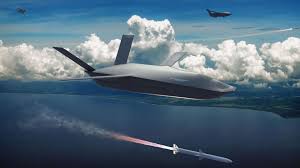
How the United States Now Envisions Drone Warfare Through Two Programs: Replicator and the Drone Dominance Program
Source : linkedin.com – February 11, 2026 – Codja Orisha
Abonnez-vous au canal Telegram Strategika pour ne rien rater de notre actualité
Pour nous soutenir commandez les livres Strategika : “Globalisme et dépopulation” , « La guerre des USA contre l’Europe » et « Société ouverte contre Eu
“Multi-spectrum dominance” is now extending into the drone domain through two major programs. The first is the Replicator Program, launched in 2023 under the Biden administration, and the second is the Drone Dominance Program, launched in 2025 under the current Trump administration.
Replicator: One Billion Dollars to Counter the Chinese Military’s Numerical Superiority
The main objective of Replicator is to offset the Chinese military’s numerical superiority (more ships, more missiles) through thousands of small autonomous systems. Rather than relying solely on a few extremely expensive platforms, the United States is betting on numbers to saturate adversary defenses. This ambition therefore relies on large-scale drone production:
- Low cost: they are cheap enough to be lost in large numbers without becoming a financial disaster.
- Autonomous: they use artificial intelligence to operate independently or in swarms.
- Multi-domain: this includes not only aerial drones, but also surface drones (uncrewed boats) and underwater drones.
Replicator is structured in two phases:
Replicator 1
Launched in 2023, it aims for rapid operational deployment within 18 to 24 months (by 2025) of “all-domain attritable autonomous” (ADA2) systems: aerial, maritime, ground, underwater, and even space-based drones.
Although the Pentagon has remained discreet about the full list of ordered drones, several models have been confirmed by the Department of War (DoW), including:
- the Dive-LD, an autonomous underwater drone developed by Anduril;
- the Switchblade 600 by AeroVironment, a “suicide” drone (loitering munition) capable of destroying armored vehicles;
- the Ghost X by Anduril, a tactical drone selected for the small unmanned aerial systems program at company level;
- the C-100 by Performance Drone Works, selected for their swarm-operating capability;
- etc.
Replicator 2
Replicator 2 was launched in 2024, one year after the first iteration of the program, and focuses on defense against enemy drones (Counter-UAS or C-sUAS systems).
The most notable acquisition under Replicator 2 is the DroneHunter F700 from Fortem Technologies. Unveiled in January 2026, this reusable interceptor drone is designed to hunt other drones using onboard radar and artificial intelligence.
Replicator 2 is not limited to drones alone. It also emphasizes Command and Control (C2) systems, as well as sensors and jammers.
The Limits of the Replicator Program
As the program progressed, The Wall Street Journal revealed in September 2025 that the Pentagon’s initiative “to deploy thousands of autonomous drones to counter China’s growing military power had failed.”
According to i24NEWS, citing the WSJ, the Replicator program, with an initial budget of around $1 billion, encountered several technical obstacles:
- some platforms proved underperforming, too expensive, or too slow to mass-produce;
- the Pentagon failed to develop software capable of effectively coordinating drone fleets from different manufacturers, a prerequisite for simultaneous strikes.
The Drone Dominance Program: How to Mass-Produce Around 300,000 Drones
The Drone Dominance Program (DDP) is a Pentagon initiative aimed at flooding U.S. armed forces with disposable small attack drones.
Although it shares Replicator’s “mass” objective, it differs in scale, cost, and technological focus. The goal is to mass-produce around 340,000 low-cost attack drones (limited to small aerial drones, sUAS and FPV) by 2027, turning them into mass-consumption battlefield assets rather than rare, high-tech products.
Launched under the leadership of Secretary of War Pete Hegseth, the program has a budget of $1.1 billion, including about $150 million allocated to prototype orders immediately after the March 2026 trials.
To meet program targets, rapid competitions known as “Gauntlets” are organized, during which military personnel test drones under real operational conditions.
The first phase (Gauntlet I) began in February 2026 with 25 selected companies.
These include former defense contractors and drone-sector startups that have demonstrated not only their ability to build prototypes, but also to scale production and develop software compliant with military standards.
Ultimately, five finalists will be selected for mass production. Meanwhile, 22 U.S. companies, two Ukrainian firms (General Cherry Corp and Ukrainian Defense Drones Tech Corp), and one Israeli company, XTEND Reality, remain in the competition. XTEND operates a headquarters and production facility in Tampa, Florida, inaugurated on May 1, 2025.
Selected U.S. companies include, among others: Auterion Government Solutions Inc., Ascent AeroSystems Inc., Farage Precision LLC, Griffon Aerospace Inc., Kratos SRE Inc., Teal Drones Inc., and Performance Drone Works LLC.
Key Differences Between Replicator and Drone Dominance