
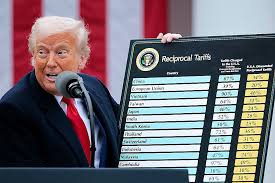
The US Supreme Court Strikes Down President Trump’s Global Tariffs
By Rosy Mylene Meza
Abonnez-vous au canal Telegram Strategika pour ne rien rater de notre actualité
Pour nous soutenir commandez les livres Strategika : “Globalisme et dépopulation” , « La guerre des USA contre l’Europe » et « Société ouverte contre Eu
In one of the most significant cases in recent history, Learning Resources, Inc. v.
Trump, the United States Supreme Court has struck down President Donald J. Trump’s
global emergency tariffs. In a 6-3 decision, the justices have ruled on Friday, February
20, 2026, that Trump’s tariffs are illegal. This has implications far beyond the tariffs
themselves, as Donald Trump and his administration have used his tariff scheme to
exert great political leverage over allies and foes alike.
Of a 170-page opinion, the short and sweet key language, penned by Chief Justice
John G. Roberts, Jr., a conservative jurist appointed by George W. Bush in 2005, reads
thusly,
“We decide whether the International Emergency Economic Powers Act (IEEPA)
authorizes the President to impose tariffs.” This is the question of law for which the
Court granted certiorari.
“We claim no special competence in matters of economics or foreign affairs. We claim
only, as we must, the limited role assigned to us by Article III of the Constitution.
Fulfilling that role, we hold that IEEPA does not authorize the President to impose
tariffs.” This is the holding, the Court’s ultimate decision.
The ruling invalidated specific « Liberation Day » tariffs, not all of Trump’s actions,
and was a 6-3 split with the conservative wing of the court dividing over the
interpretation of executive authority. Executive authority directly implicates the
Separation of Powers mandate, a key constitutional balancing principle of the US
tripartite system of government.
The constitutional separation of powers applies to the President’s imposition of
emergency tariffs. The Court has affirmed that the President cannot use the
International Emergency Economic Powers Act (IEEPA) to unilaterally impose tariffs,
affirming that the power to regulate commerce and set tariffs resides with
Congress under Article I.
It must be said that the decision was not unexpected, as based on recent 2024–2026
Supreme Court rulings, particularly regarding executive authority, the legal
argument the justices have found most convincing is formalism based on the original
public meaning of the Constitution, which demands that Congress exclusively exercise
legislative power and the President not usurp it. In other words, the Court looks to the
original intent of the Founding Fathers, who drafted the far-seeing, elastic
Constitution, a marvel of legal craftmanship.
While the 2025 IEEPA-based tariffs were struck down by the Supreme Court, the
Administration has already announced the imposition of 15% tariffs globally, although
that number may change with the rapidity of a runaway train. It does not take a crystal
ball to assume the authorities are looking for other avenues to pursue tariffs and
thus try to retain greater leverage in geopolitical terms.
Questions remain as to how the tariffs collected by the Administration will be
refunded. Donald Trump and his administration have already labeled the US Supreme
Court decision “vague”. There is nothing vague about the holding of the Court in
Learning Resources, Inc. v. Trump.
In the United States, the doctrine of stare decisis is a fundamental legal principle
requiring courts to follow precedents established by previous court decisions when
ruling on similar cases. Stare Decisis ensures legal consistency, predictability and the
stability of the legal system. Stare Decisis, the protective guardian against chaos,
operates vertically and horizontally. This means that lower courts are bound by the
rulings of higher courts and that courts must follow their own prior decisions.
As to the impact of the Supreme Court ruling regarding the obligations of
sovereign states to the United States under trade agreements relying on the
imposition of emergency tariffs, there is no legal question. The agreements were
null and void ab-initio. In other words, trade agreements based on ILLEGAL premises
are invalid at inception. Although big law firms in the US and their friendly law firms
abroad will do their best to paint the issue as a grey area, it is not.
Lastly, and in praise of the true American Spirit, this momentous case was brought by
the courage of five small business who sought to have the Constitution of the United
States unfurl its economic protection to what is called Main Street. In the United States,
“Main Street” is a term that denominates small business and shops located in the main
street of the downtown area of a city. Most of these businesses are family-owned and
have served the public for generations. This is significant because smaller
businesses were unable to absorb the effects of the Trump’ tariffs, as their margins
are not as excessive as the mayor corporations. Neither did they have the political clout
to request tariff exceptions.
Sometimes, the greatest courage, that which liberates societies and states from
economic and other harm, starts in small and humble places. In this case, from 5 small
businesses, including an importer of wine and an online store selling fishing tackle. May
the blessings codified by the Founding Fathers, men of faith, extend throughout the
United States and the world at large